
High End Cafes Are Becoming Lifestyle Brands, Not Beverage Businesses
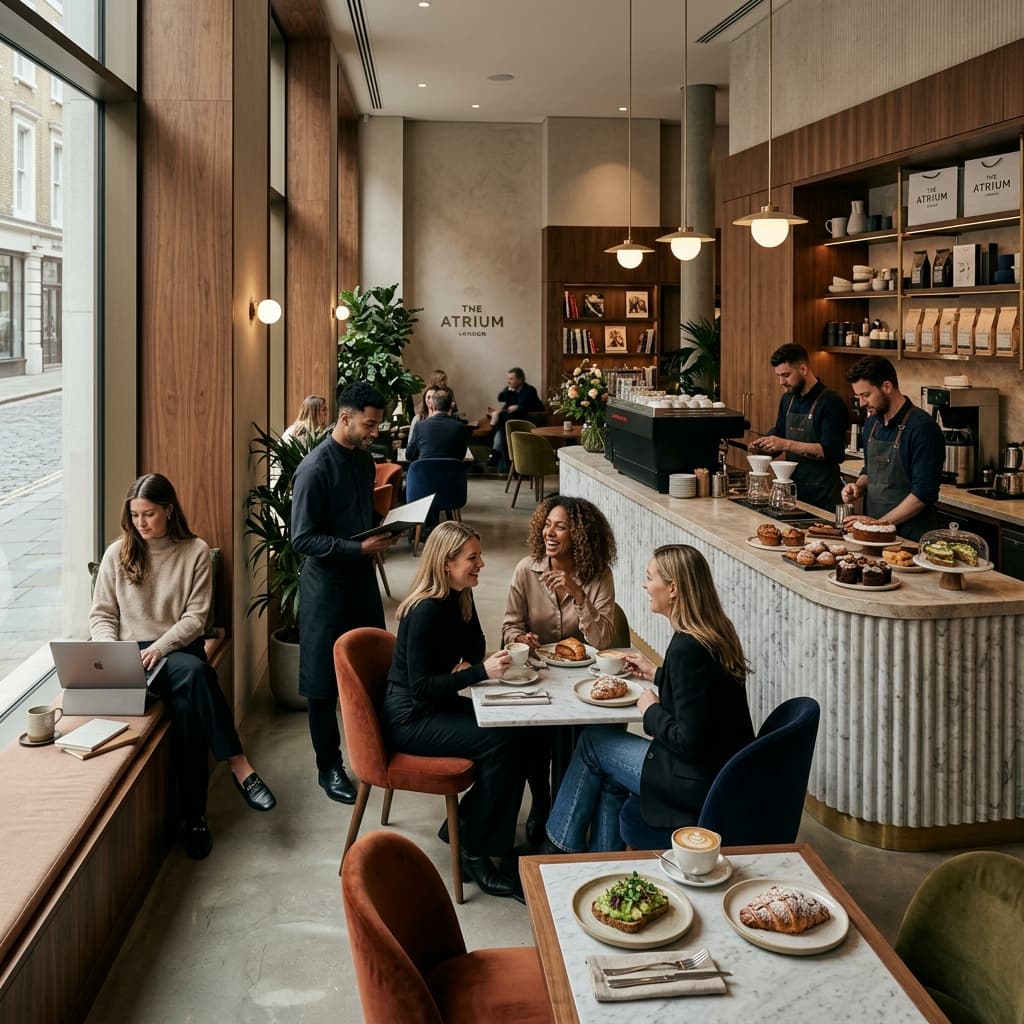
The premium cafe is no longer competing only on what is inside the cup. It is competing on why the customer wants to be inside the space at all. India's cafes and bars market is estimated at US$18.83 billion in 2025 and is projected to reach US$30.11 billion by 2030, representing a 9.84% CAGR according to Mordor Intelligence's India Cafes and Bars market analysis. At the same time, India's specialty coffee market was valued at US$3.01 billion in 2025 and is forecast to reach US$6.52 billion by 2031, growing at a 13.75% CAGR, according to TechSci Research.
The strategic implication is clear:
The premium cafe opportunity is shifting from beverage differentiation toward experience differentiation.
A cappuccino can be replicated.
A pour over can be replicated.
A matcha menu can be replicated.
Even the interior aesthetic can be copied.
What becomes significantly harder to replicate is a place that has become part of a customer's identity, routine, social life, workday, and memory.
That is the emerging economics of cafe branding.
The question for premium cafe operators is therefore no longer:
“Can we make a better beverage?”
It is:
“Why would a customer choose our space repeatedly when another cafe can offer a comparable product?”
The market is growing, but growth is making differentiation harder
The Indian cafe market is entering a much more competitive phase.
Mordor Intelligence's 2025 India Cafes and Bars analysis estimates the market at US$18.83 billion in 2025, with projected growth to US$30.11 billion by 2030.
That growth is attracting more operators.
More specialty coffee brands.
More independent cafes.
More premium chains.
More design led spaces.
More cafes positioned around work, community, wellness, culture, and lifestyle.
Growth therefore creates a paradox.
The larger the category becomes, the harder it becomes for an individual cafe to remain distinctive.
When specialty coffee was less developed, the product itself could create differentiation.
Today, consumers can encounter single origin coffee, alternative brewing methods, premium desserts, matcha, cold brew, artisanal bakery products, and carefully designed interiors across an expanding number of locations.
The product is becoming easier to access.
The experience is becoming the differentiator.
Specialty coffee is becoming a larger category, but specialty alone is not enough
The growth of specialty coffee demonstrates that consumers are becoming more interested in quality and product provenance.
TechSci Research's India Specialty Coffee Market report estimates the category at US$3.01 billion in 2025, with projected growth to US$6.52 billion by 2031.
That represents a 13.75% CAGR.
This is commercially significant.
But there is an important strategic limitation.
If multiple cafes offer high quality beans, sophisticated brewing, knowledgeable baristas, and premium presentation, then specialty coffee itself becomes a category expectation rather than a unique positioning advantage.
The question changes from:
“Do you serve specialty coffee?”
to:
“What does your cafe mean beyond specialty coffee?”
That is where premium brand identity becomes commercially important.
The cafe is becoming a place people use, not simply a place people visit
The traditional cafe transaction is simple.
Customer enters.
Customer orders.
Customer consumes.
Customer leaves.
The emerging premium cafe model is different.
A customer may enter to meet a friend.
Another may work for two hours.
Another may attend a community event.
Another may photograph the space.
Another may read.
Another may hold a business meeting.
Another may visit because a particular pastry has become popular.
Another may simply want somewhere that feels different from home.
The Coffee Board of India's October to December 2025 publication specifically describes cafes evolving into workspaces, leisure spots, and community hubs, with visually striking interiors and fusion menus becoming part of the appeal.
This is a significant shift.
The customer is not purchasing only coffee.
The customer is purchasing access to an environment.
That environment has economic value.
Dwell time can become a commercial asset when the space is designed correctly
Dwell time is often treated as an operational problem.
A customer sitting for two hours while purchasing one coffee can appear less attractive than a customer completing a quick transaction.
But this interpretation is incomplete.
A longer stay can become commercially valuable if the cafe has designed the environment to encourage additional purchases.
A customer who stays longer may order:
A second beverage.
Dessert.
Breakfast.
Lunch.
A snack.
A specialty drink.
A retail product.
Another customer may bring a colleague.
Another may return later.
The commercial objective is therefore not simply to maximize table turnover.
It is to optimize revenue generated by the relationship between space, time, and spend.
A premium cafe needs to understand its own economics.
Average transaction value.
Visits per customer.
Revenue per seat.
Revenue per square foot.
Peak utilization.
Off peak utilization.
Average dwell time.
Repeat frequency.
These metrics reveal whether the environment is actually generating commercial value.
There is no credible universal revenue per square foot figure that applies to every premium cafe because rent, city, format, seating density, service model, menu mix, and operating hours vary substantially.
The strategic value comes from measuring the metric internally and comparing performance across locations and time periods.
The strongest cafe brands turn frequency into habit
Luxury hotels often focus on occupancy.
Restaurants focus on covers.
Cafes have another powerful metric:
frequency.
A customer who visits once every three months has a very different economic value from one who visits three times every week.
This is why premium cafe branding should be designed around habit formation.
A cafe becomes significantly more valuable when customers develop reasons to return.
Morning coffee.
Afternoon work.
Weekend brunch.
Friday evening meetups.
Seasonal menu launches.
Community events.
Coffee tastings.
Creative gatherings.
The customer should not have only one reason to visit.
The brand should create several.
Community is becoming a form of customer retention
A cafe can create a relationship that goes beyond the transaction.
A regular customer knows the barista.
The barista knows the customer's usual order.
The customer recognizes other regulars.
Events create familiarity.
The interior becomes recognizable.
The cafe becomes associated with a particular neighborhood or social group.
This is not merely atmosphere.
It is retention infrastructure.
A customer who feels socially connected to a place has more reasons to return than a customer who sees the cafe as a commodity beverage outlet.
This is one reason community can become a competitive advantage.
Competitors can copy the menu.
They cannot easily copy an existing community.
The economics of premium pricing depend on perceived value
A premium cafe cannot charge more simply because its furniture looks expensive.
The customer needs a reason to believe the experience is worth more.
Research supports this broader principle.
A 2024 study examining willingness to pay for premium restaurant experiences found that gastronomic involvement mediated the relationship between several experience related factors and willingness to pay a price premium. The study analysed 641 restaurant customers and identified factors including health value, chef image, bandwagon effects, and snob effects in shaping gastronomic involvement and willingness to pay. Journal of Quality Assurance in Hospitality and Tourism
The implication for cafes is straightforward.
Premium pricing works when customers perceive additional value.
That value can come from:
Product quality.
Ingredient provenance.
Design.
Service.
Social identity.
Exclusivity.
Convenience.
Atmosphere.
Community.
Brand reputation.
Experience.
The premium is therefore not created by the beverage alone.
It is created by the total proposition.
Ambience has moved from decoration to commercial strategy
A beautiful cafe interior is easy to photograph.
That does not automatically make it commercially powerful.
The stronger question is whether the physical environment changes customer behavior.
Does it increase visit frequency?
Does it encourage longer stays?
Does it increase average spending?
Does it encourage social sharing?
Does it create repeat behavior?
Does it make customers bring other people?
Does it create recognition?
Does it support premium pricing?
Aesthetic design becomes commercially useful when it changes these variables.
This is the difference between decoration and hospitality branding.
Decoration makes the space attractive.
Brand strategy makes the space meaningful.
The best premium cafes are designed as recognizable worlds
The strongest lifestyle brands create worlds.
The customer enters and immediately understands the brand.
The materials communicate something.
The music communicate something.
The scent communicates something.
The menu communicates something.
The staff communicate something.
The packaging communicates something.
The language communicates something.
The customer leaves with a coherent impression.
That coherence creates recognition.
Recognition creates familiarity.
Familiarity can create preference.
Preference can create frequency.
Frequency creates customer lifetime value.
This is the commercial sequence that premium brand identity should be designed to support.
Cafe branding should extend beyond the physical location
The modern cafe experience begins before arrival.
A customer may discover the brand through Instagram.
Search for the location on Google.
Look at photographs.
Read reviews.
Study the menu.
Watch a short video.
Send the location to a friend.
Then visit.
This means the cafe's digital identity becomes part of the hospitality experience.
If the physical space looks premium but the website feels generic, the brand becomes inconsistent.
If the Instagram feed communicates one personality but the interior communicates another, the brand becomes fragmented.
If the menu looks sophisticated but the service feels transactional, the promise breaks.
The strongest cafe brands create continuity across every touchpoint.
Social discovery turns the cafe into a media channel
A premium cafe has something most traditional beverage businesses do not naturally possess.
It has a physical environment that can generate content.
A distinctive entrance.
A signature table.
A dramatic coffee preparation ritual.
An open kitchen.
A recognizable cup.
A unique pastry.
A seasonal installation.
A memorable service moment.
These become visual assets.
The customer can become a distributor of the brand.
This creates an important economic shift.
The cafe is no longer only purchasing advertising.
The environment itself can create discoverability.
The stronger the identity, the more recognizable the resulting content can become.
This is why experiential dining and social discovery increasingly overlap.
The product still matters, but it becomes the foundation rather than the entire brand
There is a danger in overcorrecting.
Experience cannot compensate indefinitely for poor coffee.
A beautiful cafe with mediocre products eventually loses credibility.
Research into consumer preferences in Indian restaurants reinforces the importance of product quality. A study examining consumer patronage and willingness to pay found that food quality had a strong role in consumer preferences, particularly within higher end restaurant contexts. SSRN research on consumer patronage and willingness to pay
The lesson is not that experience replaces product.
The lesson is that premium hospitality requires both.
Product quality establishes credibility.
Experience creates differentiation.
Brand identity connects the two.
The cafe can become a lifestyle platform
Once the cafe becomes a recognizable brand, the commercial opportunities expand.
Coffee.
Food.
Merchandise.
Events.
Workspaces.
Memberships.
Private gatherings.
Workshops.
Collaborations.
Seasonal launches.
Retail coffee.
Branded products.
The physical cafe becomes the center of an ecosystem.
This is particularly relevant for premium operators because the physical location can function as a brand showroom.
The customer experiences the brand in person.
Then encounters it digitally.
Then purchases products.
Then returns to the cafe.
The relationship becomes larger than a beverage transaction.
India's market is already showing the shift toward experience led cafes
The trend is visible in current market research.
Euromonitor's 2026 India Cafes and Bars analysis notes that premium coffee experiences, seasonal launches, locally inspired beverages, and brand equity are supporting leading cafe operators.
The same analysis identifies experience oriented formats that combine comfortable interiors, premium beverage offerings, and social engagement as a major source of growth.
That is strategically important.
Experience is no longer an independent design trend.
It is becoming part of competitive positioning.
The premium cafe is increasingly asking customers to buy into a world.
The cafe's location becomes part of the brand
A high end cafe is not just inside a city.
It can become associated with a neighborhood.
A street.
A building.
A cultural district.
A particular type of customer.
This creates geographic brand equity.
A cafe can become:
“The place people go after work.”
“The weekend cafe.”
“The creative district cafe.”
“The coffee place for serious enthusiasts.”
“The cafe where meetings happen.”
“The neighborhood's social room.”
These associations are powerful because they turn location into identity.
The customer is no longer simply navigating to a cafe.
They are entering a particular social context.
Premium cafes should measure revenue per relationship, not only revenue per transaction
A single transaction provides limited information.
Suppose Customer A spends ₹350 once.
Customer B spends ₹250 but visits four times every month.
The second customer may be substantially more valuable.
This is why premium cafe operators should monitor:
Average transaction value.
Visits per customer.
Repeat visit rate.
Monthly active customers.
Average revenue per customer.
Dwell time.
Revenue per seat.
Revenue per square foot.
Food attachment rate.
Second beverage rate.
Event participation.
Customer retention.
The goal is to understand the economics of behavior.
A cafe that increases average transaction value while losing frequent customers may not have improved its brand.
A cafe that slightly lowers average transaction value but dramatically increases visit frequency may have created a much stronger customer relationship.
Retention is often the hidden advantage of a strong cafe brand
Customer acquisition is expensive.
The cafe has to attract attention.
Create awareness.
Convince the customer to visit.
Deliver a good first experience.
The second visit is different.
The customer already knows the location.
They understand the menu.
They know the environment.
They know what to expect.
The psychological cost of choosing the cafe becomes lower.
This is why strong brand identity can improve retention.
The customer does not have to rediscover the value proposition every time.
The brand has already become familiar.
Premium cafes can create a stronger emotional switching cost
The most powerful cafes create associations.
A particular table becomes someone's work spot.
A certain drink becomes part of someone's morning routine.
A particular dessert becomes associated with weekends.
A cafe becomes the place where friends meet.
A particular corner becomes part of someone's creative process.
These associations are difficult for competitors to replicate.
A competitor can copy the chair.
It cannot copy the memory.
A competitor can copy the menu format.
It cannot copy the community.
A competitor can copy the lighting.
It cannot copy the accumulated relationship.
That is the hidden moat of lifestyle branding.
The physical environment becomes a form of customer acquisition
This creates an important strategic loop.
A distinctive space attracts attention.
Attention creates discovery.
Discovery creates visits.
Visits create experiences.
Experiences create content.
Content creates further discovery.
Repeated experiences create familiarity.
Familiarity creates loyalty.
Loyalty creates frequency.
Frequency increases customer lifetime value.
The physical environment therefore becomes part of the acquisition strategy.
This is why cafe design should be evaluated commercially rather than aesthetically alone.
The premium cafe is becoming a hospitality brand
The shift is ultimately about category definition.
A beverage business sells beverages.
A premium cafe sells beverages plus environment.
A lifestyle cafe sells a recognizable identity and a place within that identity.
That distinction changes everything.
The menu becomes a brand expression.
The interior becomes a brand expression.
The staff become a brand expression.
The service ritual becomes a brand expression.
The packaging becomes a brand expression.
The customer community becomes a brand expression.
The digital presence becomes a brand expression.
This is the deeper meaning of cafe branding.
The cafe itself becomes the medium through which the brand is experienced.
What makes a customer choose one premium cafe over another?
The answer is rarely one thing.
It is the combination.
The coffee must be good enough to justify the visit.
The environment must make the visit enjoyable.
The brand must be recognizable.
The service must feel appropriate to the price.
The experience must create a reason to return.
The social environment must feel relevant.
The digital presence must reinforce the same identity.
The total experience must feel coherent.
That is what creates preference.
The new cafe competitive advantage is not the cup
The specialty coffee market is growing.
India's cafes and bars market is growing.
More consumers are experimenting with premium beverages.
More cafes are investing in design.
More brands are entering the category.
The result is predictable.
The beverage becomes easier to replicate.
The environment becomes more important.
The community becomes more important.
The brand becomes more important.
The experience becomes more important.
The premium cafe of the future will therefore compete less like a traditional beverage outlet and more like a hospitality brand.
Its objective will not simply be to sell another coffee.
It will be to become a place the customer wants to return to.
A place they want to be seen in.
A place they associate with their lifestyle.
A place they recommend.
A place they remember.
And eventually, a place they miss when it is not available.
The real value of a premium cafe is the relationship it creates
The strongest premium cafe is not necessarily the one with the most expensive coffee.
It is the one that creates the strongest reason to return.
That reason can be taste.
It can be atmosphere.
It can be community.
It can be design.
It can be service.
It can be identity.
It can be convenience.
But the strongest brands combine several of these elements into one coherent experience.
That is where luxury cafes become more than beverage businesses.
They become lifestyle brands.
And when the customer begins choosing the cafe because of what the place represents rather than only what the cup contains, the economics of the business change.
The product remains essential.
But the brand becomes the reason to come back.
The future of premium cafes will not be won by whoever makes the most sophisticated beverage.
It will be won by whoever creates the most difficult experience to replace.
References
- 1. Mordor Intelligence, India Cafes and Bars Market.
- 2. TechSci Research, India Specialty Coffee Market.
- 3. Coffee Board of India, India Coffee E Magazine, October to December 2025.
- 4. Euromonitor, Cafes and Bars in India, March 2026.
- 5. Dutta, Parsa, Parsa and Bujisic, Consumer Patronage and Willingness to Pay at Different Levels of Service Attributes in Restaurants.
- 6. Journal of Quality Assurance in Hospitality and Tourism, Far Eastern Restaurant Customers' Willingness to Pay a Price Premium.
- 7. Hike My Brand Insights.
- 8. Hike My Brand Studio.