
The Restaurant Experience Is Becoming the Brand: Why Fine Dining Can No Longer Separate Food From Branding
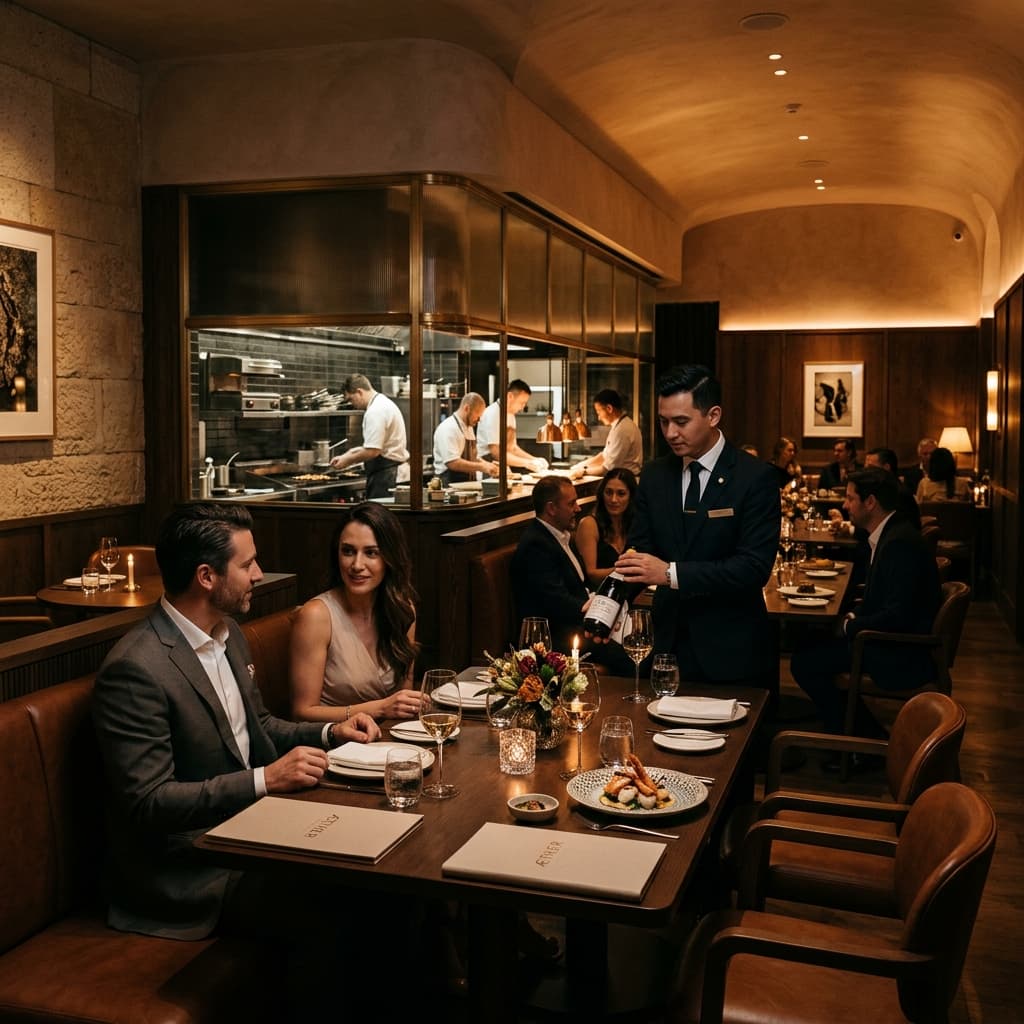
A restaurant can serve an exceptional meal and still be forgettable. Another restaurant can serve a comparable meal and become the place guests photograph, recommend, revisit, remember, and willingly pay more to experience. The difference is increasingly not the food alone. It is the total experience surrounding the food. For luxury restaurants, the strategic implication is clear: restaurant branding must move beyond visual identity and become the deliberate design of the entire guest experience. The National Restaurant Association found that 64% of full service customers consider the dining experience more important than the price of the meal. [https://go.restaurant.org/SOI2025-PR.html]
That changes the commercial question.
The question is no longer simply, “How good is the food?”
It is:
“What makes the entire experience valuable enough for a guest to choose this restaurant, pay its premium, remember it, and return?”
That is where experiential dining becomes a brand strategy rather than a design trend.
The meal is only one component of what the guest is buying
The situation is familiar across luxury hospitality.
A fine dining restaurant can invest heavily in ingredients, culinary talent, wine programs, and menu development. Yet two restaurants can offer comparable food while producing completely different levels of perceived value.
The complication is that guests do not evaluate a restaurant using a single variable.
They experience the lighting before the first course arrives.
They notice the architecture.
They hear the room.
They interact with the host.
They read the menu.
They watch the service choreography.
They see the plating.
They observe the kitchen.
They decide whether the staff remembers them.
They photograph the experience.
They talk about it afterward.
Every one of these moments contributes to the mental picture of the restaurant.
The restaurant therefore becomes more than a place where food is served.
It becomes a medium through which the brand communicates.
That is why restaurant branding increasingly has to be understood as experience design. You can explore more hospitality brand strategy through the Hike My Brand Insights Hub.
Experience has become a measurable source of differentiation
The most important evidence is not coming from branding agencies. It is coming from diners themselves.
According to the National Restaurant Association's 2025 State of the Restaurant Industry, 64% of full service customers said their dining experience was more important than the price of the meal. Among limited service customers, the figure was 47%.
The same research found that 90% of fine dining operators considered increasing on premises business more important to their success than increasing off premises business.
This matters because fine dining is fundamentally an on premises proposition.
A luxury restaurant cannot reproduce its complete value through a delivery box.
Its value exists in the room.
It exists in the interaction.
It exists in the sequence of moments that happen between arrival and departure.
This creates an important strategic distinction.
A restaurant selling only food competes primarily on food.
A restaurant selling an experience can compete on a much larger collection of variables.
That creates more opportunities to differentiate and more reasons for a guest to accept a premium.
The premium is increasingly attached to the experience around the plate
The willingness to pay for experience is not limited to restaurants.
According to the JLL Global Consumer Experience Survey, consumer willingness to pay a premium for high quality experiences increased from 65% in 2024 to 69% in 2025.
For luxury restaurants, this creates a powerful commercial implication.
The premium cannot simply be explained by expensive ingredients.
A guest can often find high quality ingredients elsewhere.
The premium comes from the complete interpretation of those ingredients.
The dining room gives the meal context.
The service gives it personality.
The menu gives it narrative.
The architecture gives it atmosphere.
The plating gives it visual identity.
The rituals give it memory.
The consistency gives it trust.
Together, these elements create something that is much harder for competitors to copy.
This is the economic foundation of a premium brand identity.
Discovery has moved outside the restaurant, making the experience part of the marketing system
A restaurant's brand now begins forming before a guest enters the building.
The first interaction may happen on Google.
It may happen through Instagram.
It may happen through a friend's photograph.
It may happen through a review.
It may happen through a restaurant's website.
It may even happen through an AI assisted search experience.
Research reported by SevenRooms through Quirks found that 94% of diners use online resources such as Google, social media, and media sites to discover new restaurants. Among Gen Z diners, 69% rely on social media for restaurant discovery.
That means the physical experience has acquired a second life online.
The dining room is no longer experienced only by the people sitting inside it.
Its visual language can appear on thousands of screens.
A distinctive plate can become content.
A dramatic entrance can become content.
An open kitchen can become content.
A recognizable table setting can become content.
A memorable service ritual can become content.
A signature dessert can become content.
The restaurant therefore becomes both a physical hospitality environment and a digital media environment.
That is a major shift in restaurant branding.
The most valuable restaurant assets are increasingly designed to be remembered
A conventional marketing model treats marketing as something that happens before the transaction.
Experiential dining challenges that model.
The experience itself can generate future demand.
Research published in the International Journal of Hospitality Management in 2026 found that the aesthetic appeal and familiarity of user generated food photographs can influence tourists' intentions to visit restaurants.
This is important because it changes how restaurant operators should think about design.
Aesthetic design is not merely decoration.
It can become a discovery mechanism.
But there is an important distinction.
A restaurant should not design an experience merely because it photographs well.
It should design an experience that is meaningful enough to photograph because it is genuinely distinctive.
That difference separates experiential dining from visual gimmickry.
Loyalty is worth more than constant acquisition
Restaurant operators often focus heavily on acquiring new guests.
That is understandable.
New guests create traffic.
But the economics of a restaurant become significantly more attractive when discovery turns into repeat behavior.
Data from Toast and Resy provides a striking illustration. Just 7% of a restaurant's guest base accounted for multiple visits, yet this group could generate up to 50% of total order volume.
Toast also found that Resy Regulars averaged 8.30 reservations at an average of 1.45 restaurants over three years, compared with 5.45 visits at an average of 2.4 restaurants for Non Regulars.
The strategic implication is substantial.
The most valuable guest is not necessarily the person who discovers the restaurant today.
It is the person who decides that the restaurant is now one of their places.
That transition from visitor to regular is where restaurant branding becomes commercially powerful.
The brand creates recognition.
The experience creates emotional attachment.
The operational consistency creates trust.
The combination creates repeat visitation.
Personal recognition can turn service into brand equity
Luxury hospitality has always understood the power of recognition.
But current data shows just how large the gap remains between what guests want and what restaurants consistently deliver.
According to Toast's 2026 guest recognition research, 48% of diners said being remembered by name or by their usual order was what made them feel most valued, while only 30% said that level of recognition always happened at their regular restaurants.
Toast also found that recognized guests were 80% more likely to try new items and 77% more likely to tip more.
This is not simply a service statistic.
It is a branding statistic.
Being remembered communicates something about the relationship between the restaurant and the guest.
It says:
“You are not anonymous here.”
That feeling is extremely difficult to create through advertising.
It has to be experienced.
This is why premium restaurant branding cannot stop at the logo, menu, website, or campaign.
The staff member who remembers a guest's preference is also delivering the brand.
The host who recognizes a returning guest is delivering the brand.
The chef who explains a dish in a distinctive way is delivering the brand.
The restaurant manager who handles a problem gracefully is delivering the brand.
The brand lives inside the operation.
The menu is becoming a piece of brand architecture
Menu design is often treated as a functional requirement.
For luxury restaurants, that is an underestimation of its strategic role.
The menu is one of the first sustained pieces of communication a guest experiences inside the restaurant.
Its typography communicates sophistication.
Its descriptions communicate personality.
Its sequence communicates how the chef wants the guest to experience the meal.
Its pricing communicates positioning.
Its categories communicate philosophy.
Its physical material communicates quality.
Even the decision to keep a menu intentionally concise can become part of the brand.
A restaurant positioned around simplicity should not have a chaotic menu.
A restaurant positioned around discovery should not present the guest with a completely predictable structure.
A restaurant built around heritage should make its culinary story visible.
The menu should therefore behave like an extension of the restaurant's strategic positioning.
The dining room is no longer background scenery
Interior design has historically been discussed in terms of aesthetics.
For luxury restaurants, that is too narrow.
The physical environment controls a significant portion of the guest's emotional experience.
Lighting affects perceived intimacy.
Acoustics affect comfort.
Table spacing affects privacy.
Materials affect perceived quality.
Seating affects dwell time.
Kitchen visibility affects transparency.
Entrance design affects anticipation.
The room therefore acts as a behavioral system.
A high end cafe may deliberately create a setting that encourages longer stays and repeat visits.
A fine dining restaurant may use controlled lighting, spacing, and acoustics to create intimacy.
A luxury hotel restaurant may connect architecture, service, and destination identity to create a sense of exclusivity.
These are not independent design decisions.
They are components of the same brand system.
For brands looking to translate strategy into a stronger visual and physical identity, Hike My Brand Studio provides the broader brand strategy and creative context behind this approach.
The strongest experiential concepts make every touchpoint tell the same story
The danger of experiential dining is fragmentation.
A restaurant may have beautiful interiors, an impressive social presence, and an excellent menu while delivering an inconsistent service experience.
That does not create a strong brand.
It creates disconnected impressions.
A premium restaurant needs coherence.
The visual identity should align with the physical environment.
The physical environment should align with the menu.
The menu should align with the service style.
The service should align with the culinary philosophy.
The culinary philosophy should align with the restaurant's digital presence.
The digital presence should set an expectation that the physical experience can actually deliver.
This is where Hike My Brand Insights becomes relevant to the broader hospitality conversation.
A brand is strongest when strategy, identity, experience, and operational delivery reinforce one another rather than operating as separate departments.
Social discovery creates a new requirement: the experience must be distinctive without becoming performative
There is a temptation to interpret the rise of social discovery as an instruction to make restaurants more photogenic.
That would be the wrong conclusion.
The objective should not be maximum shareability.
It should be memorable distinctiveness.
The difference matters.
A gimmick can create attention.
A coherent experience can create preference.
Research from NielsenIQ and Zonal found that 74% of consumers would visit a venue that provides an elevated experience.
The research also connects experiences beyond ordinary food and drink with opportunities to increase bookings, recommendations, repeat visits, loyalty, and spending.
The implication is that experiential dining should be designed around genuine value.
The question should not be:
“What will people post?”
The better question is:
“What will people remember?”
The second question produces stronger brands.
Customer acquisition becomes more efficient when the experience markets itself
There is no universally reliable industry benchmark for restaurant customer acquisition cost because acquisition economics vary substantially by market, concept, average check, customer frequency, and acquisition channel.
That absence of a universal benchmark is itself strategically important.
Restaurant operators should calculate their own acquisition economics.
A simple framework is:
Customer acquisition cost = total acquisition and marketing spend divided by new guests acquired
But this figure becomes more meaningful when connected to repeat behavior.
If a restaurant spends $1,000 to acquire a new guest who visits once and spends $2,000, the economics are very different from acquiring a guest who returns six times.
This is why experience matters financially.
A memorable experience can convert acquisition into retention.
And retention can change the lifetime economics of the guest.
According to Toast's restaurant loyalty research, enrolling guests into loyalty programs shifted return rates from a 7% baseline to nearly 30%, approximately a fourfold increase.
For luxury restaurants, the broader lesson is not simply to introduce a loyalty program.
It is to understand what makes guests want to return.
The answer is usually more complicated than a discount.
The premium restaurant is selling memory as much as food
This is ultimately the central commercial insight.
Guests can compare menu prices.
They can compare ingredients.
They can compare restaurant ratings.
They can compare photographs.
But they cannot easily compare the feeling of being welcomed into one particular room at one particular moment.
That feeling is created through accumulated details.
The lighting when they arrive.
The greeting they receive.
The first drink.
The pace of the meal.
The story behind a dish.
The sound of the room.
The interaction with the chef.
The final course.
The way the bill is presented.
The goodbye.
These moments become memory.
Memory becomes preference.
Preference becomes loyalty.
Loyalty becomes revenue.
That is the commercial chain connecting experiential dining to restaurant branding.
What luxury restaurants should measure now
If experience is becoming the brand, restaurant operators need to measure more than covers and average check.
A modern luxury restaurant dashboard should connect five dimensions.
Discovery
Track how guests found the restaurant through search, social platforms, referrals, editorial coverage, and other channels.
Conversion
Track the proportion of discovered guests who make reservations and ultimately arrive.
Experience
Track guest satisfaction, reviews, recognition, service recovery, and qualitative feedback.
Retention
Track repeat visitation, reservation frequency, guest lifetime value, and the proportion of guests becoming regulars.
Commercial value
Track average check, premium menu adoption, beverage attachment, private dining revenue, and revenue generated by repeat guests.
This creates a much more complete understanding of restaurant performance.
It also turns restaurant branding from an aesthetic discipline into a measurable commercial strategy.
The future of restaurant branding will be built inside the dining room
The restaurant industry is becoming increasingly competitive while consumers are becoming more deliberate about where they spend.
The National Restaurant Association's second quarter 2026 consumer survey found that 56% of consumers had dined at a restaurant in the previous week, but 36% reported spending less at restaurants than in the previous quarter. [https://restaurant.org/research-and-media/research/restaurant-economic-insights/economic-indicators/quarterly-consumer-insights-survey/]
That combination creates pressure.
Guests are still going out.
But they are becoming more selective about where their money goes.
In that environment, a restaurant needs more than good food.
It needs a reason to matter.
That reason may be the atmosphere.
It may be the service.
It may be the culinary story.
It may be the architecture.
It may be the feeling of being recognized.
But the strongest luxury restaurants will combine all of these elements into one coherent proposition.
The brand will not sit above the experience.
The experience will be the brand.
And the restaurants that understand this earliest will have a significant advantage in building premium positioning, repeat visitation, stronger guest relationships, and long term brand equity.
The real answer to the premium question
So what actually makes a guest willing to pay more for the same meal?
Not one thing.
It is the accumulated perception that the meal is part of an experience they cannot easily reproduce somewhere else.
They pay for the setting.
They pay for the attention.
They pay for the confidence that every detail has been considered.
They pay for recognition.
They pay for atmosphere.
They pay for storytelling.
They pay for consistency.
Most importantly, they pay for the memory they expect to take away.
That is why the future of experiential dining will not be defined by restaurants that simply look impressive.
It will be defined by restaurants where every touchpoint reinforces a distinctive promise.
The dining room becomes media.
The menu becomes communication.
The service becomes storytelling.
The guest becomes the distribution channel.
And the experience becomes the most valuable expression of the brand.
References
- 1. National Restaurant Association, 2025 State of the Restaurant Industry.
- 2. JLL Global Consumer Experience Survey.
- 3. SevenRooms restaurant discovery research reported by Quirks.
- 4. Toast and Resy Regulars Report 2026.
- 5. Toast Guest Recognition Research 2026.
- 6. Toast Restaurant Loyalty Research.
- 7. NielsenIQ and Zonal research on elevated dining experiences.
- 8. International Journal of Hospitality Management research on user generated food photography and restaurant visit intentions.
- 9. National Restaurant Association, Quarterly Consumer Insights Survey.
- 10. Hike My Brand Insights.
- 11. Hike My Brand Studio.